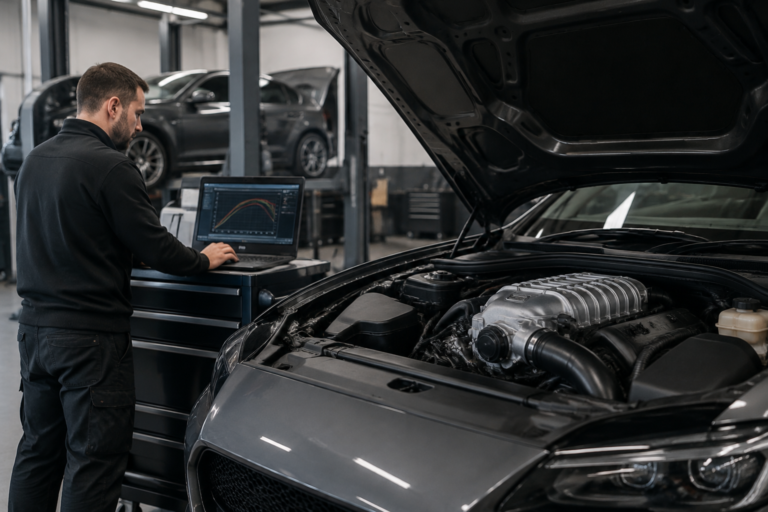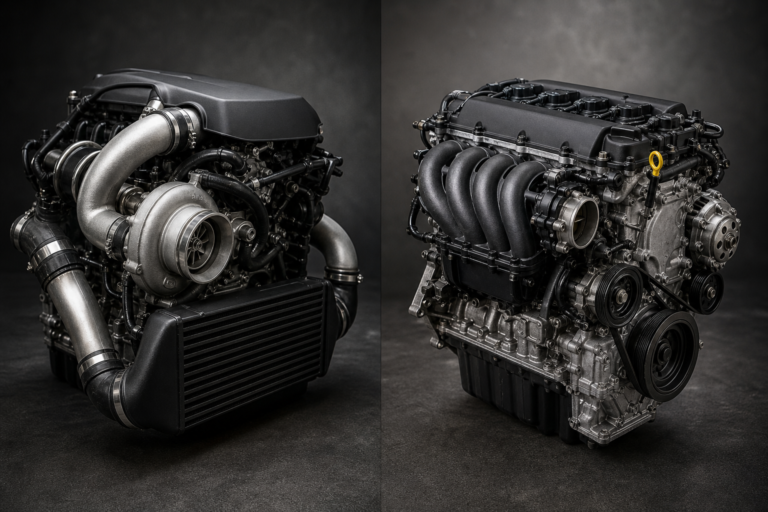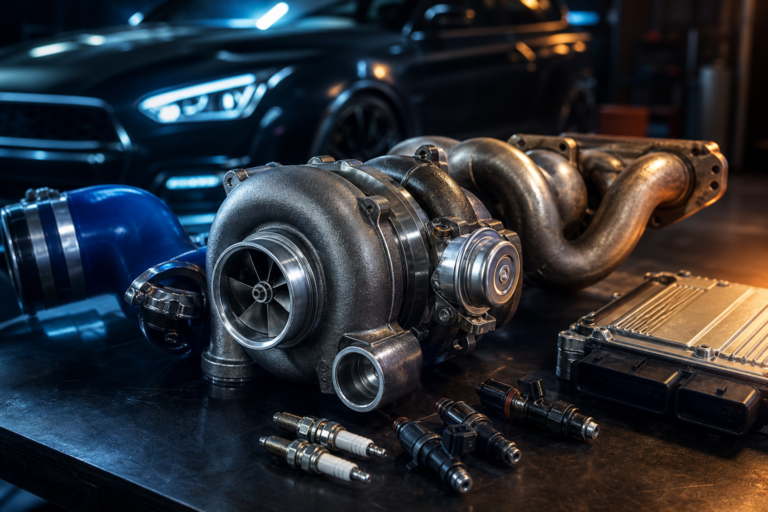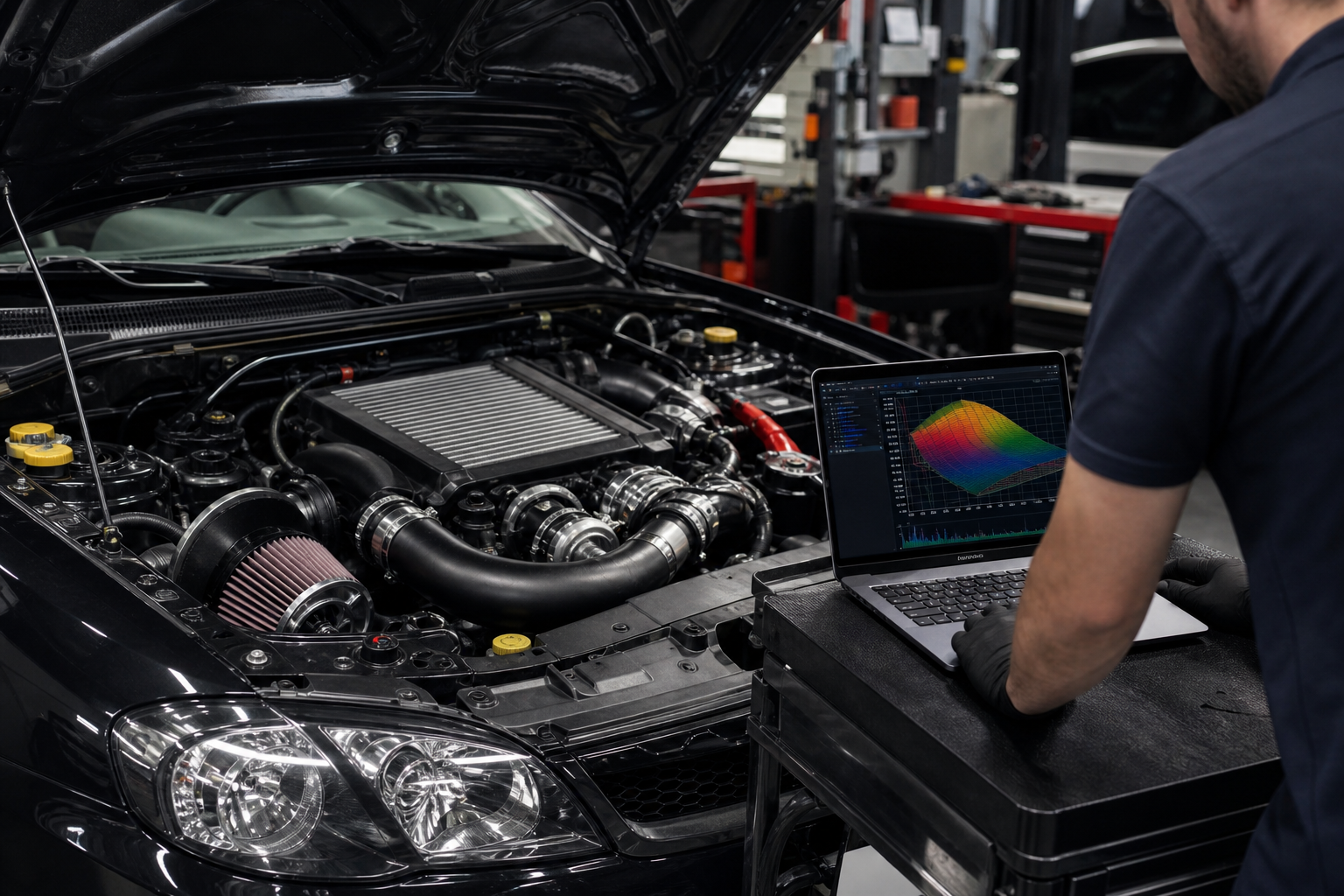
Stage 2 remapping requirements are best decided from the vehicle’s actual configuration rather than a generic parts list. This guide helps you decide what to provide for an assessment, what to ask about fuelling, cooling, exhaust configuration and ECU compatibility, and when unresolved faults or missing information should be addressed before calibration is considered.
What Stage 2 usually means in practice
“Stage 2” is a useful shorthand, but it is not a universal technical specification. One vehicle’s Stage 2 calibration may not be suitable for another, even where the engines appear similar, because hardware configuration, mechanical condition and fuel quality can differ.
Modern engine management coordinates several targets, including fuel delivery, petrol-engine ignition timing, turbo boost control and torque requests. A higher-stage calibration should therefore be considered as a system change, not as an adjustment to one isolated value.
Before treating a proposed setup as suitable, establish:
- the exact engine and ECU configuration;
- the vehicle’s current mechanical condition and any unresolved faults;
- the hardware already fitted; and
- the fuel quality for which the calibration is intended.
This avoids assuming that a file or hardware list described with the same stage label will suit every otherwise similar vehicle.
Why supporting hardware can matter
An ECU remap may increase demand on the engine and drivetrain, which can expose existing weaknesses or reduce available margin under harder use. Supporting changes should therefore be considered against the vehicle’s condition, intended use and proposed calibration—not assumed from a stage label alone. RCR REMAPS’ guide to remapping and reliability identifies cooling, fuel and ignition systems, boost-related faults and drivetrain condition as areas worth investigating where symptoms or the proposed use make them relevant.
A vehicle-specific assessment framework
- Fuelling: establish the intended fuel and disclose any fuel-system, ignition or running concerns. The assessment question is whether fuel quality and the vehicle’s current condition match the assumptions for the proposed calibration.
- Cooling and temperature control: explain whether the vehicle will see repeated high-load use and report overheating, coolant loss or temperature-history concerns. This helps determine whether further investigation is needed before work proceeds.
- Exhaust configuration: provide an accurate description of the exhaust and any related fault information. Ask whether its current configuration creates a specific issue for the proposed work; do not assume that a generic list of exhaust changes applies to every vehicle.
- ECU compatibility: provide the exact vehicle, engine and ECU details where available, together with any known previous software or electrical work. Confirm that the proposed route is being considered for that configuration rather than for an apparently similar car.
The owner should also provide a current modification list, intended fuel, typical use and known faults. Requirements remain vehicle-specific: the useful outcome is a clear explanation of what is already known, what needs checking and whether a particular change is actually required for this setup.
Diagnostic checks and data logging can be discussed as part of validation to compare commanded and measured behaviour; the exact checks should be confirmed with the provider. For further context, see Turbocharged Petrol Tuning: Boost, Temperature and Calibration Considerations.
Calibration and hardware should match
Turbocharged petrol tuning should be assessed as a change in operating demand, not as a single boost-pressure adjustment. For a Stage 2 enquiry, the useful question is not simply which parts are fitted, but which identified limitation a proposed change is intended to address.
Ask the provider to consider the vehicle and engine, ECU, existing hardware, intended fuel and any known faults together before deciding whether a calibration is compatible. A calibration suitable for one engine, hardware configuration or fuel quality should not automatically be assumed suitable for an otherwise similar car.
- Name the limitation: ask what mechanical or calibration requirement a suggested modification addresses.
- Confirm the existing configuration: provide an accurate list of fitted parts rather than relying on a generic stage description.
- Clarify the calibration basis: ask whether the proposed file is being considered against the car’s ECU, hardware and fuel arrangement.
- Challenge generic add-ons: if no specific limitation is identified, ask why the modification is necessary for this vehicle.
This approach avoids treating a parts list as a substitute for an assessment. It also gives the owner a clearer basis for comparing proposed work and deciding whether further investigation is needed first.
Vehicle-health checks first
This section is about finding issues that should be investigated before calibration, not choosing supporting modifications. Calibration suitability depends on the vehicle’s mechanical condition and the absence of unresolved faults, so disclose anything that could affect the assessment.
- Fault information: provide warning-light details, stored fault information and recurring drivability concerns rather than assuming the calibration will resolve them.
- Mechanical condition: ask what condition checks are appropriate for the specific vehicle before work is considered.
- Intake, fuel and cooling: ask whether these areas need investigation in light of the vehicle’s condition and proposed calibration, without assuming that a generic parts list applies.
- Validation evidence: ask whether diagnostic checks or data logging will be used to compare commanded and measured behaviour during calibration validation.
The ECU coordinates fuel delivery, petrol-engine ignition timing, turbo boost control and torque requests. The relevant question is therefore whether those targets can be assessed together on this vehicle, rather than whether one isolated symptom or parameter can be treated as conclusive.
If faults remain unresolved, ask whether further diagnosis should come before Stage 2 consideration. A calibration should also retain safety, diagnostic and emissions-control strategies rather than disable or bypass them to achieve a requested output.
What not to assume from a stage label
Stage 2 should not be treated as a single boost-pressure change. On a turbocharged petrol engine, tuning is a change in overall operating demand, and the ECU coordinates fuel delivery, ignition timing, turbo boost control and torque requests.
That makes a stage label a starting point for discussion, not a promise of universal gains or a fixed shopping list. A higher-stage calibration may depend on hardware capability, thermal control and airflow, but the relevant supporting modifications vary with the engine and its existing setup.
- Do not assume that every vehicle needs the same fuelling, cooling or exhaust configuration.
- Do not fit a part solely because a generic Stage 2 label appears to call for it; ask which mechanical limitation or calibration requirement it is intended to address.
- Do not accept a requested output as a reason to disable or bypass safety, diagnostic or emissions-control strategies.
- Do not treat one apparently similar vehicle as proof that the same calibration will suit another; hardware configuration and fuel quality can differ.
In practical terms, Stage 2 remapping requirements involve deciding whether the proposed calibration, current vehicle condition and any genuinely necessary supporting changes form a suitable combination.
Questions before choosing a Stage 2 setup
Before committing, use the conversation to establish what is known, what needs checking and what remains conditional. An ECU remap may increase engine and drivetrain demand, potentially exposing worn parts or reducing the margin available under hard use.
- What vehicle, engine and ECU are being assessed?
- What hardware is already fitted, and is its configuration known?
- Are there any known faults, servicing concerns or signs of worn components?
- What fuel is intended for the vehicle?
- Which proposed changes are requirements for this specific setup, and which are only possible considerations?
- How will commanded and measured behaviour be compared during calibration validation, for example through diagnostic checks and data logging?
- Will safety, diagnostic and emissions-control strategies remain in place?
These questions do not predetermine the answer. Reliability can depend on the particular engine, vehicle condition, torque delivery, servicing, fuel and driving habits.
Next step: RCR REMAPS offers vehicle diagnostics, custom ECU tuning and Stage 2 remapping. Provide the vehicle and engine details, current hardware, intended fuel and any known faults when requesting an assessment so the proposed route can be considered on its own merits.