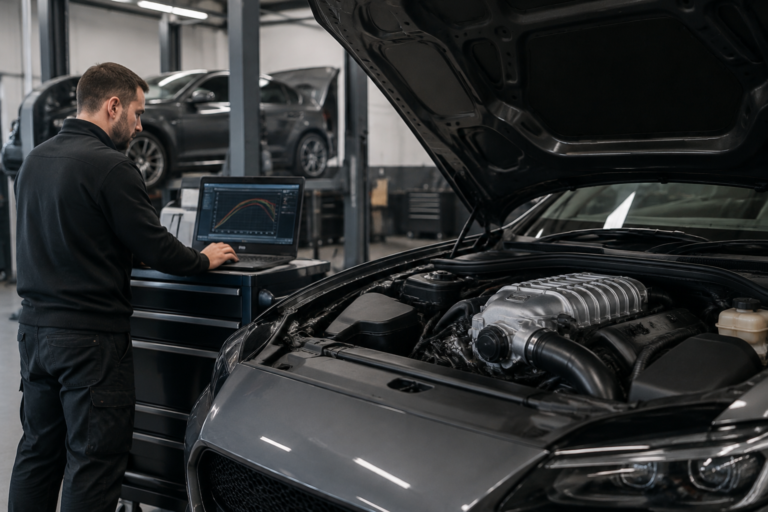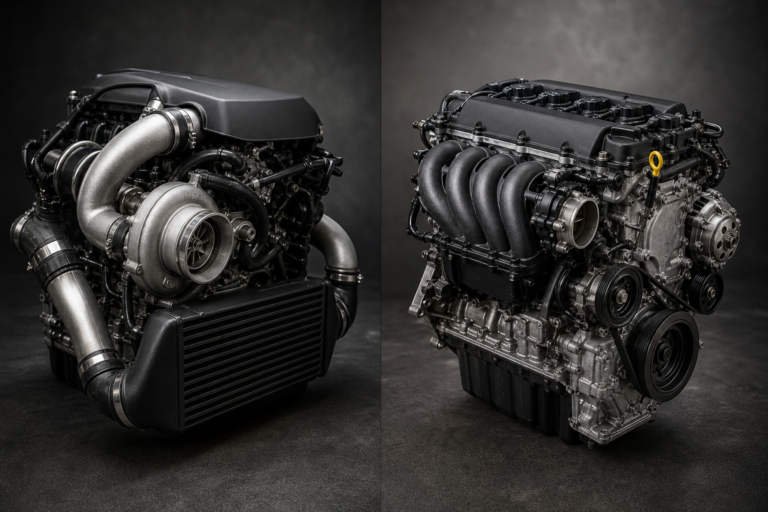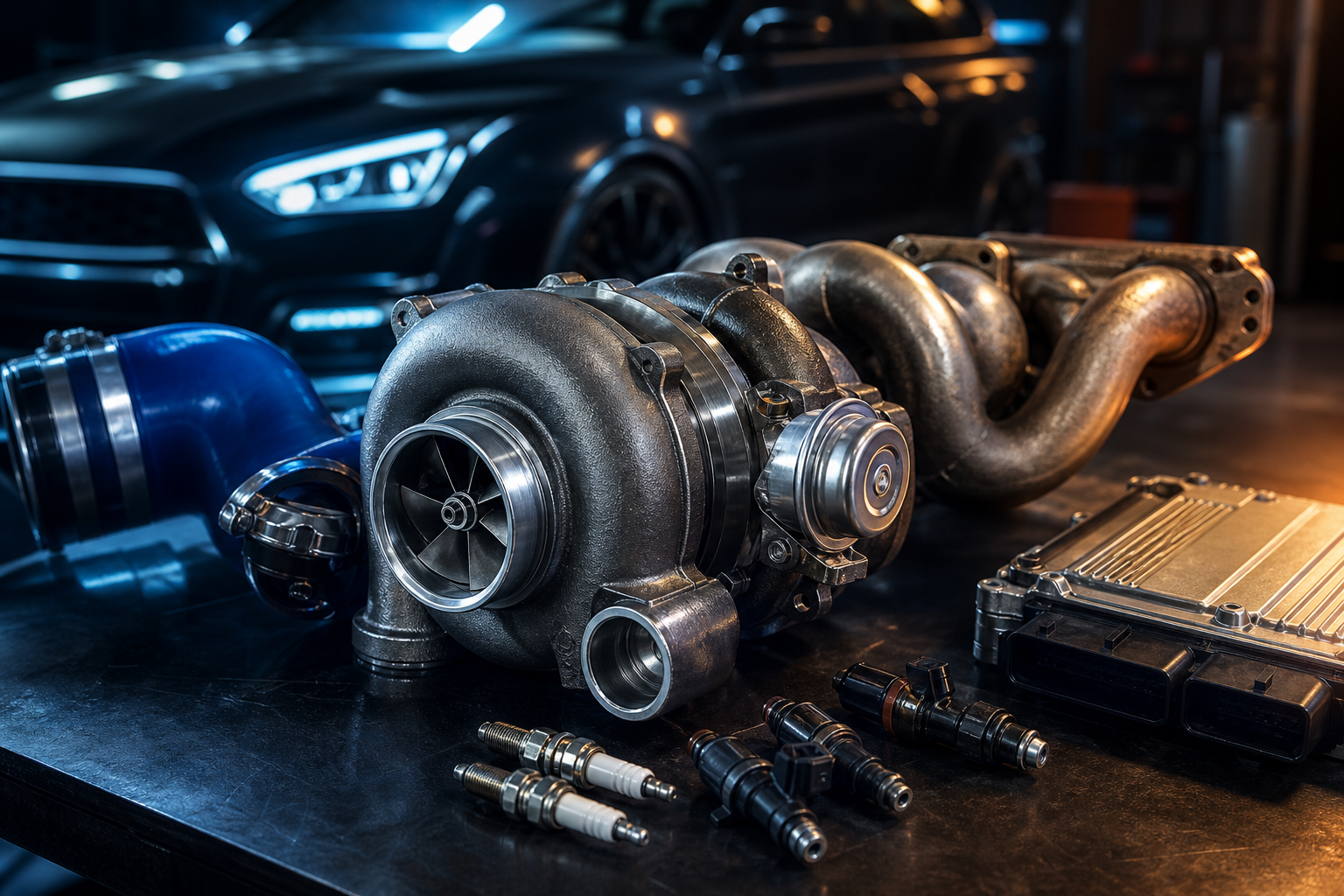
Turbocharged petrol tuning should be assessed as a change in operating demand, not as a single boost-pressure adjustment. The ECU can coordinate fuel delivery, petrol-engine ignition timing, turbo boost control and torque requests, so the reliability question depends on how those targets work together.
How turbo petrol calibration changes interact
A turbocharger compresses the intake charge, increasing the intake air mass. Any change in boost demand therefore interacts with fuelling, ignition and torque control rather than standing alone.
Modern engine management coordinates multiple control targets. A sensible calibration approach treats the system as connected: boost demand should be considered with actual airflow, charge temperature and knock-related behaviour, rather than by pressure alone.
For a petrol engine, the key relationship is not simply whether a higher boost target is requested, but whether the combined calibration targets remain appropriate for the conditions in which the vehicle will operate.
- Boost demand: affects the compressed intake charge and therefore the air mass involved.
- Fuelling: works with petrol-engine lambda control across differing load conditions, helping to manage combustion and component temperatures.
- Ignition timing: influences combustion phasing; knock control may retard timing when conditions reduce knock margin.
- Torque control: forms part of the wider set of ECU targets that must be considered alongside boost, fuel and ignition.
This is why a calibration suitable for one engine, hardware configuration or fuel quality should not automatically be assumed suitable for every otherwise similar vehicle. Diagnostic checks and data logging can help compare commanded behaviour with measured behaviour during validation.
Knock margin, fuel quality and charge-air temperature
Fuel quality is a calibration assumption, not a minor detail. Fuel octane and quality can affect knock margin, so the fuel used should match the assumptions made during validation. A calibration considered suitable for one fuel quality should not automatically be treated as suitable for another.
Charge-air temperature is a separate operating condition to clarify with the tuner. Higher charge-air temperature can reduce knock margin and make repeated high-load performance less consistent. The useful decision is therefore whether the vehicle’s expected use and fuel match the conditions considered during calibration, rather than whether a particular boost figure sounds appealing.
- Ask which fuel quality and octane assumptions apply.
- Explain whether the vehicle will see repeated high-load use.
- Ask how changes in charge-air temperature are taken into account.
- Do not treat one fuel or one set of conditions as representative of every use case.
Torque delivery and driveline considerations
For turbocharged petrol tuning, ask how any revised torque request is intended to be delivered across the rev range, rather than judging the calibration by one headline setting. Torque control is one of several ECU targets that should be considered alongside boost, fuelling and ignition.
This matters because the vehicle may encounter different operating conditions across the rev range. The appropriate question is whether the proposed torque delivery suits the specific engine, hardware configuration, fuel assumptions and mechanical condition—not whether a similar vehicle received the same approach.
- Ask how torque delivery is expected to vary across the rev range and operating conditions.
- Confirm that the calibration is being considered for the specific engine and hardware configuration.
- Discuss any existing hesitation, vibration, unusual noises or transmission concerns before proceeding.
- Ask what evidence will be used to compare requested behaviour with measured behaviour.
These questions do not establish that any particular clutch, gearbox or driveline is suitable; they ensure that torque delivery is considered as part of the vehicle-specific calibration discussion.
Vehicle-health checks before calibration
Calibration suitability depends on the vehicle’s mechanical condition and the absence of unresolved faults. Tuning is not a fix for mechanical, electrical or emissions-related problems, so existing concerns should be identified before a calibration decision is made.
For a turbocharged petrol engine, a sensible baseline discussion can include spark plugs, ignition coils, fuel delivery and intake integrity. These factors can affect how consistently the engine operates. They should be treated as checks to investigate, not as a diagnosis of a fault from the information in an article.
- Declare warning lights, stored faults and unresolved running issues.
- Ask whether spark plugs, ignition coils, fuel delivery or intake integrity need checking.
- Confirm that mechanical, electrical or emissions-related problems will not be treated as something a remap can cure.
- Ask what diagnostic checks will establish the vehicle’s baseline before calibration.
If a fault is suspected, professional diagnostics are the appropriate next step. Establishing the baseline first helps distinguish a calibration decision from repair work.
What good validation should look for
Validation is something to ask a provider to explain, not a guaranteed description of every provider’s process. The useful question is how the proposed calibration will be assessed against the vehicle’s actual condition, hardware configuration, fuel assumptions and intended use.
- Which commanded and measured behaviours, if any, will be compared?
- How will the assessment account for the vehicle’s intended use rather than one isolated observation?
- What fuel assumptions apply, and how will charge-air temperature and knock margin be considered?
- How will unresolved mechanical, electrical or emissions-related issues be identified before calibration?
- How will repeated high-load use and the associated thermal demand be considered?
Diagnostic checks and data logging can help compare commanded and measured behaviour during calibration validation, but the exact checks should be confirmed with the provider. A calibration suitable for one engine, hardware configuration or fuel quality should not automatically be assumed suitable for every otherwise similar vehicle.
Questions to ask before choosing a calibration
Use the conversation with a provider to establish what is being assessed, what assumptions are being made and what evidence will be reviewed. These questions can help keep the decision focused on the vehicle rather than on a headline claim.
- What fuel quality is assumed for the proposed calibration and its validation?
- How will boost-related behaviour be considered alongside airflow, temperature and knock-related behaviour?
- How are petrol fuelling and lambda control considered across differing load conditions?
- What diagnostic checks and logged data will be used to compare commanded and measured behaviour?
- How will repeated high-load use and thermal demand be taken into account?
- What vehicle-specific factors could mean that an apparently similar car requires a different approach?
- Are there any mechanical, electrical or emissions-related faults that should be resolved first?
For a practical next step, set out the vehicle’s current condition, hardware configuration, typical use and intended fuel when requesting advice. RCR REMAPS offers ECU remapping and vehicle diagnostic services; you can contact RCR REMAPS to discuss your vehicle and the information needed before choosing a calibration.