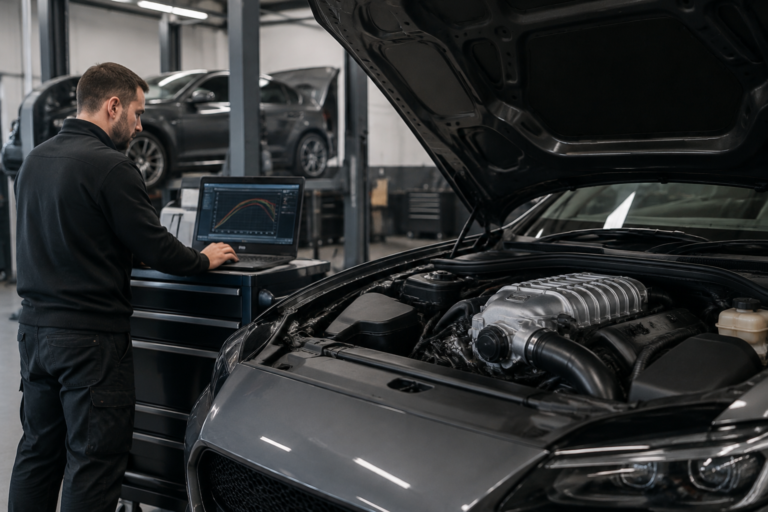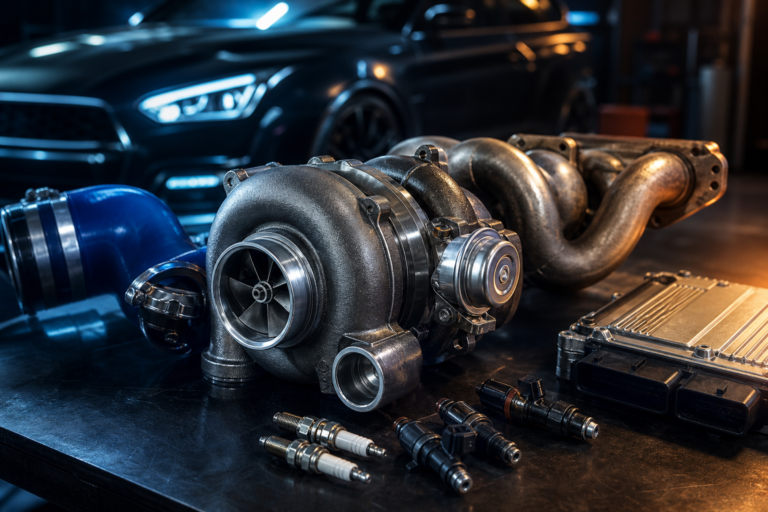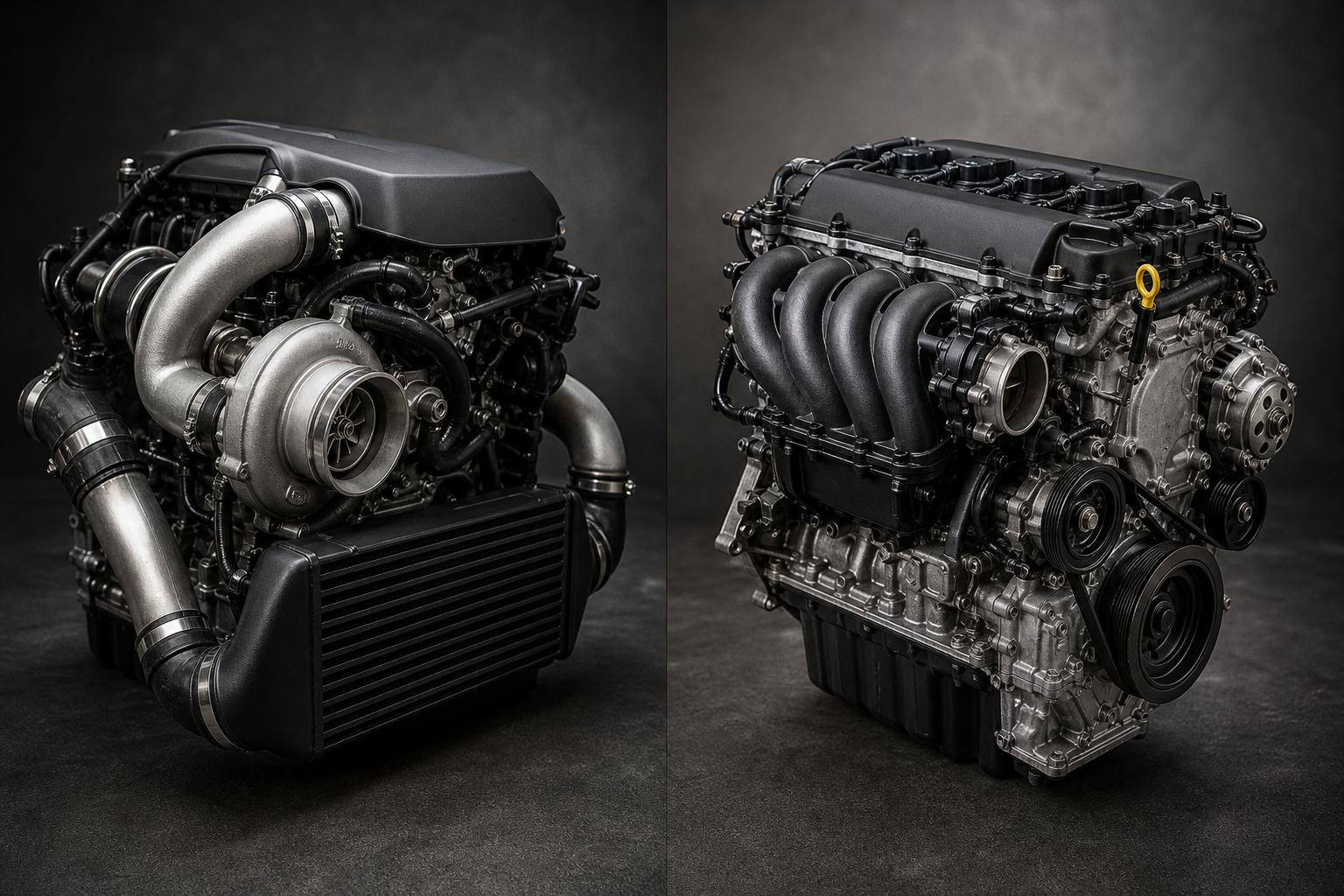
Petrol engine remapping affects turbocharged and naturally aspirated engines differently. On a turbocharged engine, calibration changes can alter boost demand alongside airflow, fuelling, ignition and torque-control targets, so the change should be assessed as a shift in overall operating demand rather than as a single boost adjustment. A naturally aspirated engine has no turbo boost to adjust; its calibration is more constrained by the airflow, compression, cam timing, fuelling and ignition characteristics of the existing setup.
How turbo petrol calibration changes interact
In practical terms, remapping means changing selected ECU calibration targets for the vehicle and then checking how the vehicle behaves; the controls available and the appropriate changes depend on the particular engine and ECU.
A turbocharger increases intake air mass by compressing the intake charge. Boost demand therefore interacts with fuelling, ignition and torque-control targets, while the ECU coordinates fuel delivery, petrol-engine ignition timing, turbo boost control and torque requests.
That is why turbocharged petrol tuning should be assessed as a change in operating demand, not as a single boost-pressure adjustment. Boost control is better considered alongside actual airflow, temperature and knock-related behaviour.
A naturally aspirated petrol engine has no turbo boost to adjust. Its calibration changes remain constrained by the airflow, compression, cam timing, fuelling and ignition characteristics of the existing setup. This difference helps explain why a change that is relevant to a turbocharged engine cannot simply be assumed to suit a naturally aspirated one.
Knock margin, fuel quality and charge-air temperature
Fuel assumptions matter because fuel octane and quality can affect knock margin. A calibration should match the fuel assumptions used during validation, rather than assuming that a setting suitable for one fuel will suit every fuel quality.
Higher charge-air temperature can reduce knock margin and make repeated high-load performance less consistent. Ignition timing influences combustion phasing, while knock control may retard timing when operating conditions reduce that margin.
Petrol-engine fuelling and lambda control help manage combustion and component temperatures across different load conditions. Sustained higher load also increases thermal demand on the engine, turbocharger, charge-air and cooling systems.
Useful questions for a calibration provider include:
- What fuel quality assumptions were used during validation?
- How are charge-air temperature and knock-related behaviour considered?
- Will the vehicle’s mechanical condition and any unresolved faults be assessed first?
- Can commanded and measured behaviour be compared through diagnostic checks and data logging?
A calibration suitable for one engine, hardware configuration or fuel quality should not automatically be assumed suitable for every otherwise similar vehicle.
Torque delivery and driveline considerations
The practical driveline question is not simply whether an engine produces more peak output, but how torque is delivered and whether the vehicle’s existing clutch, gearbox and driveline are in suitable condition for the intended use. An ECU remap may increase engine and drivetrain demand, which can expose worn parts or reduce the margin available under hard use.
Torque delivery can change without implying a large increase in peak output. That makes the vehicle’s usual use relevant: repeated hard acceleration and other demanding conditions should be discussed rather than assuming that a calibration suitable for one vehicle will suit every similar example.
- Is there any existing concern about clutch, gearbox or driveline behaviour under load?
- How will the proposed calibration shape torque delivery, rather than focusing only on peak-output claims?
- Has the vehicle’s condition, servicing and previous use been considered?
- Would a more conservative torque-delivery approach be appropriate if worn parts or demanding use are concerns?
The outcome depends on the specific engine and vehicle condition, how torque is delivered, servicing, fuel and driving habits; this is why driveline suitability should be treated as a vehicle-specific decision.
Vehicle-health checks before calibration
A calibration should start from a healthy baseline. Suitability depends on the vehicle’s mechanical condition and the absence of unresolved faults, so a provider should establish whether issues need attention before the ECU is calibrated.
- Fault status: ask whether diagnostic faults have been checked and whether unresolved issues could affect the calibration or ECU writing process.
- Ignition system: spark plugs and ignition coils can affect how consistently a tuned petrol engine operates.
- Fuel delivery: confirm that fuel-delivery behaviour is appropriate for the intended calibration and its fuel assumptions.
- Intake integrity: include intake condition in the baseline checks because it can affect consistent operation.
- Vehicle-specific suitability: do not assume that a calibration suitable for one engine, hardware configuration or fuel quality suits every otherwise similar vehicle.
These checks are about establishing the starting condition, not promising a particular result. Diagnostic checks can identify faults that should be resolved first; the vehicle’s servicing, fuel and normal driving conditions should also be part of the discussion before proceeding.
What good validation should look for
Validation should compare commanded and measured behaviour rather than judging a calibration by one isolated parameter or a headline claim. Diagnostic checks and data logging can help show whether the vehicle is behaving as intended during the conditions considered.
- Compare commanded with measured behaviour: ask which relevant values will be reviewed and how differences will be interpreted.
- Check repeatability: ask whether behaviour is reviewed more than once, rather than relying on a single encouraging result.
- Consider operating conditions: ask how sustained higher load and the resulting thermal demand on the engine, turbocharger, charge-air and cooling systems are considered.
- Match the validation assumptions: confirm that the engine, hardware configuration and fuel quality used for validation reflect the vehicle being calibrated.
For a turbocharged engine, boost control should be considered alongside actual airflow, temperature and knock-related behaviour rather than boost pressure alone. For a naturally aspirated engine, validation should respect the existing airflow, compression, cam timing, fuelling and ignition characteristics, because there is no turbo boost to adjust.
A useful final question is what evidence will be reviewed if commanded and measured behaviour do not align. That keeps validation focused on observed vehicle behaviour rather than an assumed outcome.
Questions to ask before choosing a calibration
Use the conversation to establish how the proposed calibration has been matched to the particular vehicle, rather than focusing on a single headline change.
- How will the calibration account for the relationship between fuel delivery, ignition timing, torque requests and, where fitted, turbo boost control?
- What fuel assumptions were used during validation, and should the vehicle continue to use that fuel?
- What logged behaviour will be reviewed after the calibration, and how is repeatability assessed?
- How are sustained-load temperature demands considered during validation?
- For a naturally aspirated engine, how does the proposal reflect its existing airflow, compression, cam timing, fuelling and ignition characteristics?
- If the vehicle’s hardware, condition or fuel differs from the validation assumptions, what should be reviewed before proceeding?
The reliability question depends on how the ECU’s fuel, ignition, torque and, where applicable, boost targets work together. An ECU remap may increase engine and drivetrain demand, potentially exposing worn parts or reducing margin under hard use; that does not mean every remapped vehicle becomes unreliable, as the outcome depends on the engine, vehicle condition, torque delivery, servicing, fuel and driving habits.
Practical next step: Take a clear list of your vehicle’s specification, servicing history and usual fuel to a tuning provider, then ask for an explanation of the validation approach before deciding whether a calibration is appropriate.