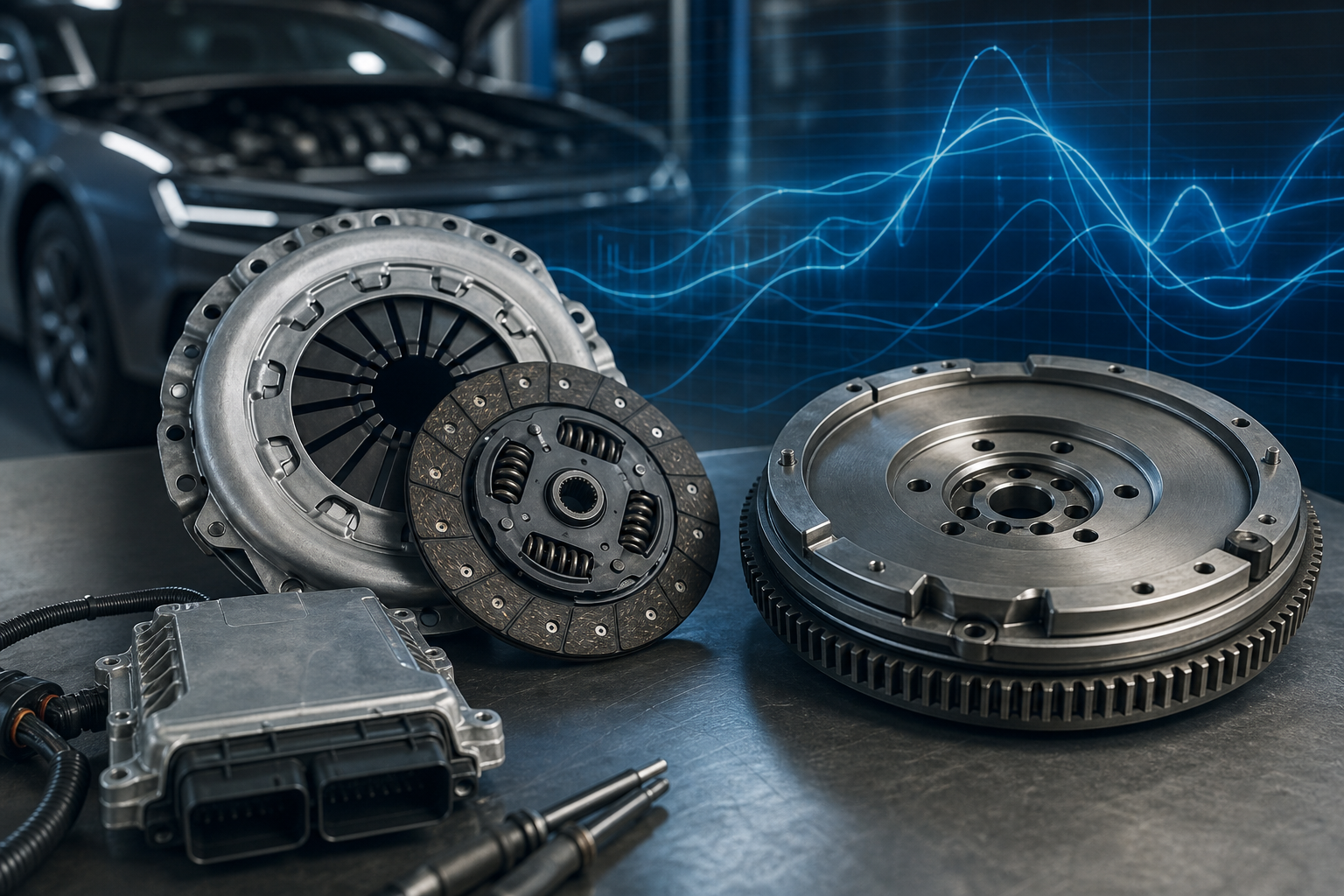
Yes, ECU remapping can affect the clutch and dual-mass flywheel (DMF), mainly because a torque increase places greater demand on the drivetrain. A well-calibrated remap does not automatically cause these parts to fail. However, if a clutch is already near its wear limit, or a DMF has developing wear, the additional torque can make the problem noticeable sooner.
This is why vehicle condition matters as much as the intended performance increase. Before remapping, it is sensible to deal with clutch slip, persistent judder, drivetrain noises or relevant fault codes rather than hoping tuning will not aggravate an existing issue.
Why additional torque matters
The clutch transfers engine torque into the gearbox. Its friction plate, pressure plate and associated hydraulic or cable-operated release system must provide enough clamping force to prevent slip.
ECU remapping can increase torque, particularly on turbocharged petrol and diesel engines. If that increased torque exceeds the usable capacity of a worn clutch, the engine speed may rise without a matching increase in road speed. This is clutch slip.
A dual-mass flywheel has a different role. It contains a spring-and-damper arrangement designed to reduce torsional vibration travelling from the engine into the drivetrain. Engine torque fluctuations are a primary source of those vibrations, so changes in torque delivery can alter the demands placed on the system. ([schaeffler.com](https://www.schaeffler.com/remotemedien/media/_shared_media/08_media_library/01_publications/schaeffler_2/symposia_1/downloads_11/1_Dual_Mass_Flywheel_1.pdf?utm_source=openai))
The important distinction is that a remap is not usually the original cause of a worn clutch or DMF. It can, however, reveal a weakness that was previously hidden by the vehicle’s standard torque output and gentler day-to-day use.
Can a Stage 1 remap make a clutch slip?
It can, but it is not inevitable. A healthy clutch with adequate capacity for the vehicle and calibration may continue to operate normally. A clutch already close to the limit may begin slipping shortly after a torque increase, often first under heavier load.
Typical situations where slip becomes more obvious include:
- accelerating hard in a higher gear;
- driving uphill or carrying a heavy load;
- towing, where applicable;
- using strong throttle input at low engine speed; and
- repeated stop-start driving if the clutch is already overheated or worn.
Clutch slip creates heat. Technical guidance from clutch manufacturers identifies excessive slipping as a cause of burnt friction material and heat-related flywheel damage. ([repxpert.com](https://www.repxpert.com/en/training-information/250108-transit-clutch-install?utm_source=openai))
How ECU remapping may affect a dual-mass flywheel
A DMF is not simply a heavy disc between the engine and gearbox. Its internal components help manage vibration and smoothness. The arc springs and damping system are designed for a particular drivetrain application, and their condition deteriorates with use, heat and mechanical loading.
More torque, especially if it arrives very strongly at low revs, can increase the load placed through the clutch and flywheel assembly. That does not mean every tuned vehicle will develop DMF trouble. It means an ageing or already-damaged DMF may be less tolerant of extra demand.
Signs such as grease leakage, excessive free movement, damaged bearings, heat discolouration and ineffective springs are examples of conditions that can compromise DMF operation. The correct tolerances and inspection method are specific to the flywheel design and vehicle application. ([valeoservice.com](https://www.valeoservice.com/en-com/techassist/technical-library/technical-documents/dmf-breakdown-causes-based-symptom-0?country=MA_maroc&utm_source=openai))
Warning signs to investigate before remapping
Symptoms alone cannot confirm a clutch or DMF fault; engine, gearbox, hydraulic, mounting and driveline faults can sometimes feel similar. However, the following signs are good reasons to arrange professional diagnostics before increasing torque.
Possible clutch-related symptoms
- Engine revs flare under acceleration but the vehicle does not accelerate proportionately.
- A high or inconsistent clutch biting point.
- A burning smell after pulling away, manoeuvring or accelerating under load.
- Judder, shudder or an uneven feel when moving off.
- Difficulty selecting gears, particularly with the engine running.
Possible dual-mass flywheel-related symptoms
- Rattle, knocking or clatter around idle.
- A pronounced noise or vibration when starting or switching off.
- Drivetrain vibration that changes with engine speed or clutch operation.
- Harshness or shudder that is most noticeable when pulling away.
Do not repeatedly perform aggressive high-gear acceleration tests to “prove” a clutch is slipping. If a problem is present, deliberate loading can generate more heat and worsen damage. A technician can assess the symptoms, vehicle data and mechanical condition more safely.
Why two similar vehicles can respond differently to the same remap
There is no universal mileage at which a clutch or DMF becomes unsuitable for tuning. Two apparently identical vehicles can have very different drivetrain condition because of their history.
| Factor | Why it matters |
|---|---|
| Existing component wear | A clutch with reduced friction material or a worn DMF has less margin than a sound assembly. |
| How the vehicle is used | Frequent urban driving, towing, heavy loads and repeated hill starts can increase clutch heat and wear. |
| Torque delivery | How torque is introduced through the rev range can matter as much as the headline peak figure. |
| Driving technique | Labouring the engine at low revs in a high gear can load the drivetrain heavily, particularly with strong throttle input. |
| Previous repairs | The quality, specification and installation of previous clutch or flywheel work can affect durability and behaviour. |
| Related faults | Engine running issues, oil contamination, hydraulic faults and worn mounts can contribute to symptoms or complicate diagnosis. |
What should be checked before a remap?
A pre-remap assessment should be proportionate to the vehicle, its symptoms and the intended use. It is not possible to fully inspect every clutch or DMF externally, but meaningful checks can identify warning signs and faults that should be addressed first.
- Diagnostic scan: check for engine, transmission and sensor fault codes that may affect drivability or the ECU writing process.
- Road-test observations: note any slip, judder, vibration, abnormal noise, poor gear engagement or inconsistent power delivery.
- Service and repair history: consider whether the clutch, DMF, gearbox oil or related components have been replaced, and why.
- Fluid leaks and contamination: investigate oil leaks around the engine or gearbox that could affect clutch operation.
- Intended vehicle use: discuss towing, regular heavy loads, urban driving and performance expectations before deciding on a calibration approach.
RCR REMAPS carries out diagnostic checks before remapping to identify significant faults that could interfere with tuning or ECU writing. This is valuable preparation, but it should not be treated as a guarantee that an internally worn clutch or DMF cannot fail later.
Manual, DSG and other automated gearboxes
Manual-transmission vehicles use a driver-operated clutch, while DSG and other dual-clutch or automated systems use electronically controlled clutch arrangements. The details differ, but the underlying principle remains: additional engine torque must be managed within the capability and condition of the gearbox and clutch system.
For vehicles with DSG or other automated gearboxes, engine and gearbox calibration should be considered together where appropriate. The correct approach depends on the specific vehicle, transmission, software and mechanical condition. A generic assumption based only on the vehicle badge or engine size is not a reliable basis for tuning.
Can careful calibration reduce the risk?
A custom calibration can take account of the vehicle’s condition, intended use and sensible torque delivery. Avoiding unnecessary low-rev torque spikes and not pursuing unrealistic figures can help preserve drivability and reduce avoidable drivetrain stress.
That said, calibration cannot restore worn friction material, repair damaged DMF springs or compensate for a mechanical fault. If the clutch is slipping or the DMF is clearly noisy, repair and diagnosis should come before performance tuning.
Should you remap if the clutch or DMF has been replaced?
Possibly, but replacement alone is not an automatic green light. The replacement parts need to be correct for the vehicle and fitted properly, and the rest of the drivetrain still needs to be in suitable condition. Discuss the part specification, intended use and any remaining symptoms before deciding on a remap.
It is also worth allowing any new clutch to bed in according to the component or vehicle manufacturer’s instructions before subjecting it to sustained heavy load.
Insurance and modification disclosure
Before remapping, check your motor insurance policy and tell your insurer about the modification if required. UK government guidance advises vehicle owners to contact their insurer to check whether modifications affect cover, and drivers remain responsible for ensuring that a vehicle used on the road is properly insured and roadworthy. ([gov.uk](https://www.gov.uk/legal-obligations-drivers-riders?utm_source=openai))
The practical answer
ECU remapping can affect a clutch and dual-mass flywheel indirectly because higher torque can expose existing wear and increase drivetrain loading. It does not follow that remapping will damage a healthy clutch or DMF, nor that every vehicle with higher mileage is unsuitable for tuning.
The sensible route is straightforward: resolve warning signs first, use diagnostics to identify relevant faults, be realistic about how the vehicle is used, and choose a calibration designed around the individual vehicle rather than a one-size-fits-all file.
If you are considering ECU remapping and have noticed clutch slip, vibration, rattles or drivability concerns, contact RCR REMAPS to discuss diagnostics and whether the vehicle should be checked before tuning. RCR REMAPS is based at 9B Arcal Street, Sedgley, Dudley, West Midlands.